It was 2009. Back then I loved wandering along İstiklal Avenue in Taksim (I still do, though not quite as much as I used to). One day, walking down İstiklal with my friend Cihat, he said, “I know an authentic little cafe, really lovely. Want to go?” I said, “Sure, why not,” and off we went. Even though I never managed to go back afterwards, that moment and the cafe’s name stayed etched in my memory: Erciyes Cafe. We went in. It had a really charming, authentic design. We ordered our coffees. There was a piano against one of the walls. A young guy got up and sat down at it, and that day he started playing a piece that moved me deeply. My friend half-recognized it and asked him what it was. He was playing a piece by Yann Tiersen: Comptine d’été No. 3.
Of course, back then I had never even heard of an artist called Yann Tiersen. After we left the cafe, Cihat told me, “Yann Tiersen makes music out of all kinds of unusual sounds, from door noises to all sorts of different instruments,” and played me a few of his pieces. But the piece that young man played affected me so much that as soon as I got home I started listening to all of Yann Tiersen’s albums. That is exactly how I met the accordion: through Yann Tiersen. Because on one of those albums there was a piece that touched me deeply, “L’Homme aux bras ballants”. I can honestly say that is the piece I fell in love with the accordion through.
Back then I had a little mp3 player. I had loaded all of Yann Tiersen’s albums onto it, and I listened constantly, everywhere: at school, on the bus, on the metro, on the tram.
If you have read this far, you still haven’t found the connection to the diatonic accordion, right? :) Because Yann Tiersen doesn’t play the diatonic accordion; he plays the piano-key accordion, the kind most people know in Türkiye.
So why the diatonic accordion? That is a whole different story. To tell it, I need to take you quite a way back, to my father’s youth.
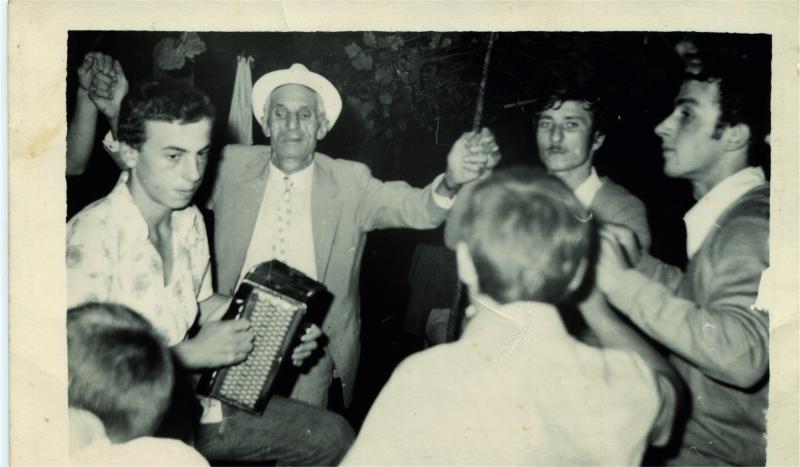
The year is 2010. One day, again while I was walking along İstiklal Avenue (yes, I was a regular), my father called. He asked, “Can you find a button accordion around there?” I didn’t even understand what it was or what he meant. Then he described it: it looks like an accordion, but smaller, and instead of piano keys it has little buttons. It turned out my father played a lot in his youth. Back then, at weddings in Rize, this instrument was hugely popular, even more sought after than the kemençe. Of course, in Rize they didn’t call it a diatonic accordion; the names people used were “armonik” or “mozika.”
With that description in hand, I started asking, one by one, at the music shops on the road down to the Tünel. I found a few old ones, but since they weren’t in good condition I kept looking for a few more days. Luckily, I found a brand-new diatonic accordion, a Hohner HA-114, at Do-Re Müzik, and after some hard bargaining I bought it. I will never forget that day. I was so excited. I told my father the news and let him hear how it sounded. The university break was coming up soon, too. When the holiday started, I went straight from Istanbul to Rize and brought the diatonic accordion to my father.
Here is my father playing it, a video I recorded in 2010, right after we got the new Hohner HA-114. This isn’t how the diatonic accordion is usually played; it’s quite different, pieces driven by the fast rhythm of Eastern Black Sea folk music and the horon. Playing this way takes a great deal of push and pull on the bellows, which makes it a pretty tiring style.
To be continued.